Secondary antibodies are antibodies that bind to primary antibodies or antibody fragments. They are typically labeled with probes that make them useful for detection, purification or cell sorting applications. Secondary antibodies may be polyclonal or monoclonal, and are available with specificity for whole Ig molecules or antibody fragments such as the Fc or Fab regions. Secondary antibodies are selected according to the source of the primary antibody, the class of the primary antibody (e.g., IgG or IgM), and the kind of label which is preferred. Identifying the optimal secondary antibody is normally done through trial and error method. Secondary antibodies are used in all types of immunoassays, most often in Western blot, immunohistochemistry, and immunocytochemistry, and occasionally in immunoprecipitation. Basic research, clinical analysis, and disease diagnosis also use secondary antibodies in ELISA and flow cytometry assays. They are also useful for cell sorting, fluorescence activated cell sorting, FACS.
Clonality:
Polyclonal
Purity:
Afinity Chromatography
Target:
Mouse IgG (H+L)
Antibody Type:
Secondary Antibody
Application Dilute:
ELISA / Western blot analysis: 1:5,000-1:20,000
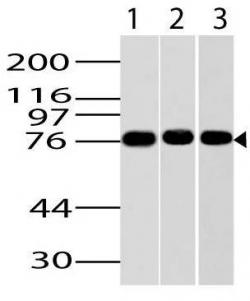
Fig-1: Western blot analysis of IKKe antibody (Clone: ABM13C7) was tested at 2 µg/ml on Jurkat, NIH 3T3 and HepG2 lysates using Goat anti Mouse IgG HRP conjugated secondary antibody (11-301) with 1:5000 dilution.
* VAT and and shipping costs not included. Errors and price changes excepted