Tyrosine kinase that functions as cell surface receptor for fibrillar collagen and regulates cell attachment to the extracellular matrix, remodeling of the extracellular matrix, cell migration, differentiation, survival and cell proliferation. Collagen binding triggers a signaling pathway that involves SRC and leads to the activation of MAP kinases. Regulates remodeling of the extracellular matrix by up-regulation of the matrix metalloproteinases MMP2, MMP7 and MMP9, and thereby facilitates cell migration and wound healing. Required for normal blastocyst implantation during pregnancy, for normal mammary gland differentiation and normal lactation. Required for normal ear morphology and normal hearing (By similarity). Promotes smooth muscle cell migration, and thereby contributes to arterial wound healing. Also plays a role in tumor cell invasion. Phosphorylates PTPN11.
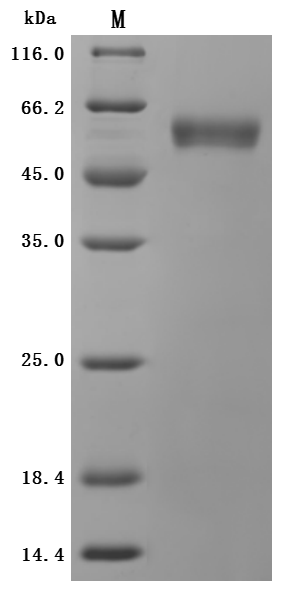
This Human DDR1 Protein spans the amino acid sequence from region 21-417aa. Purity: Greater than 95% as determined by SDS-PAGE.
Biological Origin: Homo sapiens (Human). Biological Activity: Measured by its binding ability in a functional ELISA. Immobilized Human DDR1 at 2 µg/mL can bind Anti-DDR1 recombinant antibody, the EC50 is 2.824-3.810 ng/mL. Application Notes: We recommend that this vial be briefly centrifuged prior to opening to bring the contents to the bottom. Please reconstitute protein in deionized sterile water to a concentration of 0.1-1.0 mg/mL.We recommend to add 5-50% of glycerol (final concentration) and aliquot for long-term storage at -20°C/-80°C. Our default final concentration of glycerol is 50%. Customers could use it as reference
(Tris-Glycine gel) Discontinuous SDS-PAGE (reduced) with 5% enrichment gel and 15% separation gel.
Measured by its binding ability in a functional ELISA. Immobilized Human DDR1 at 2 µg/ml can bind Anti-DDR1 recombinant antibody, the EC50 is 2.824-3.810 ng/mL.
* Mehrwertsteuer und Versandkosten nicht enthalten. Irrtümer und Preisänderungen vorbehalten