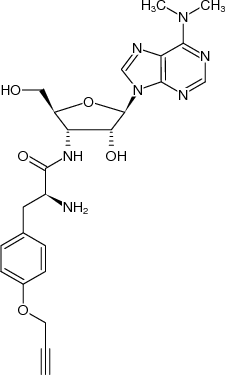
Liuet al. reported a non-radioactive alternative to analyze newly synthesized proteins in cell culture and whole organisms that is based on O-Propargyl-puromycin, an alkyne analog of puromycin. O-Propargyl-puromycin is cell-permeable and incorporates into the C-terminus of translating polypeptide chains thereby stopping translation. The resulting truncated C-terminal alkyne labeled proteins can subsequently be detected via Cu(I)-catalyzed click chemistry that offers the choice to introduce a Biotin group (via Azides of Biotin) for subsequent purification tasks or a fluorescent group (via Azides of fluorescent dyes) for subsequent microscopic imaging. In contrast to Azidohomoalanine (AHA) or Homopropargyl-gycine (HPG) based non-radioactive methionine analog-approaches, methionine free-medium is not required for O-Propargyl-purmoycin-based monitoring of nascent protein synthesis.
Solubility: DMSO, PBS (up to 50 mM tested) pH adjusted to 5.0. Application Notes: Protein synthesis monitoring in cell culture and whole organisms. Spectroscopic Propertie: lambdamax 275 nm, epsilon 20.0 L mmol-1 cm-1
Chemical structure of using O-Propargyl-puromycin.
* Mehrwertsteuer und Versandkosten nicht enthalten. Irrtümer und Preisänderungen vorbehalten