

TIA1 Rabbit Polyclonal Antibody, Unconjugated
Artikelnummer:
BYT-ORB330155
- Bilder (5)


| Artikelname: | TIA1 Rabbit Polyclonal Antibody, Unconjugated |
| Artikelnummer: | BYT-ORB330155 |
| Hersteller Artikelnummer: | orb330155 |
| Alternativnummer: | BYT-ORB330155-100 |
| Hersteller: | Biorbyt |
| Wirt: | Rabbit |
| Kategorie: | Antikörper |
| Applikation: | WB |
| Spezies Reaktivität: | Human |
| Immunogen: | The immunogen is a synthetic peptide directed towards the C terminal region of human TIA1 |
| Konjugation: | Unconjugated |
| Alternative Synonym: | anti TIA-1 antibody |
| Rabbit polyclonal antibody to TIA1 |
| Klonalität: | Polyclonal |
| Konzentration: | 0.5 mg/ml |
| Molekulargewicht: | 42 kDa |
| NCBI: | 071320 |
| UniProt: | P31483 |
| Puffer: | Liquid. Purified antibody supplied in 1x PBS buffer with 0.09% (w/v) sodium azide and 2% sucrose. |
| Formulierung: | Liquid. Purified antibody supplied in 1x PBS buffer with 0.09% (w/v) sodium azide and 2% sucrose. |
| Sequenz: | Synthetic peptide located within the following region: QAWNQQGFNQTQSSAPWMGPNYGVQPPQGQNGSMLPNQPSGYRVAGYETQ |
| Target-Kategorie: | TIA1 |
|
|
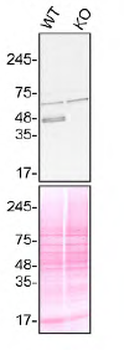
50 ug HAP1 WT and TIA1 KO lysates were subjected to SDS-PAGE followed by immunoblotting with an antibody dilution of 1/200. (right) Ponceau S staining to verify protein transfer. |
|
|
HAP1 WT and TIA1 KO cells were labelled with a green or a far-red fluorescent dye, respectively. WT and KO cells were mixed and plated to a 1:1 ratio in a 96-well plate as a mosaic culture. Cells were stained with orb330155 at a dilution of 1/500. Bars = 10um. |
|
|
TIA1 was immunoprecipitated from 2 mg HEK293 Whole Cell Lysate with orb330155 with 1:200 dilution. Western blot was performed using orb330155 at 1/1000 dilution, Lane 1: Control IP in HEK293 Whole Cell Lysate, Lane 2: TIA1 IP with orb330155 in HEK293 Whole Cell Lysate, Lane 3: Input of HEK293 Whole Cell Lysate. |
|
|
TIA1 was immunoprecipitated from HAP1 WT cell lysates using 1 ug of orb330155 coupled to Dynabeads. The Ponceau stained transfers of each blot are shown. SM=4% starting material, UB=4% unbound fraction, IP=immunoprecipitated. |
|
|
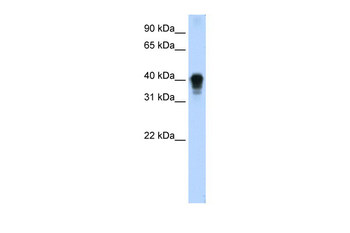
WB Suggested Anti-TIA1 Antibody Titration: 0.2-1 ug/mL, Positive Control: Human Thymus. |
Produktgarantie und fachkundiger Support
