KLH conjugated synthetic peptide derived from human ISG15. Please contact us for the exact immunogen sequence. The peptide is available as orb13009.
Konjugation:
Unconjugated
Alternative Synonym:
anti-G1P2 antibody, anti-hUCRP antibody, anti-IFI 15 antibody, anti-IFI15 antibody, anti-Interferon induced protein 15 antibody, anti-Interferon induced protein IFI-15K antibody, anti-Interferon-induced 17-kDa/15-kDa protein antibody, anti-IP17 antibody, anti-ISG 15 antibody, anti-ISG15 antibody, anti-ISG-15 antibody, anti-ISG15 ubiquitin like modifier antibody, anti-Ubiquitin cross-reactive protein antibody, anti-Ubiquitin-like protein ISG15 antibody, anti-UCRP antibody
ISG15 antibody
Klonalität:
Polyclonal
Konzentration:
- 100 µg (in 200 µl): 0.5 mg/ml- 200 µg (in 400 µl): 0.5 mg/ml
Molekulargewicht:
18 kDa
Reinheit:
Polyclonal antibodies are purified by peptide affinity chromatography
Formulierung:
10 mM PBS, 0.02% sodium azide
Target-Kategorie:
ISG15
Application Verdünnung:
IHC-P: 1:50-300, WB: 1:200-1500
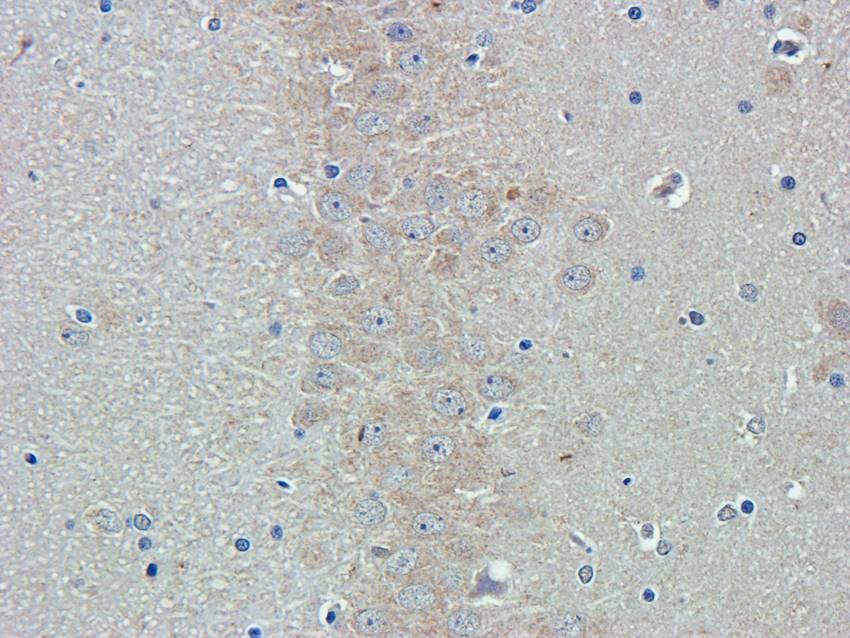
Immunohistochemical staining of paraffin embedded rat brain tissue using ISG15 antibody (primary antibody at 2.5 ug/ml)
IHC-P image of rat lymph node tissue using anti-ISG15 (dilution of primary antibody at 2.5 ug/ml)
IHC-P staining of rat lymph node tissue using ISG15 antibody (dilution at 2.5 ug/ml)
IHC-P image of rat lymph node tissue using anti-ISG15 (dilution of primary antibody at 2.5 ug/ml)
Western blot analysis of rat lymph node (lane 1), mouse brain (lane 2), mouse colon (lane 3), rat spleen (lane 4), human breast cancer (lane 5), Hela cells (lane 6) using
WB analysis of rat lymph node (lane 1), mouse brain (lane 2), mouse colon (lane 3), rat spleen (lane 4), human breast cancer (lane 5), Hela cells (lane 6) using
* Mehrwertsteuer und Versandkosten nicht enthalten. Irrtümer und Preisänderungen vorbehalten