0.02 M Potassium Phosphate, 0.15 M Sodium Chloride, pH 7.2
Quelle:
Golden Syrian Hamster
Formulierung:
Lyophilized
Application Verdünnung:
ELISA: User Optimized, IHC: User Optimized, WB: User Optimized
Anwendungsbeschreibung:
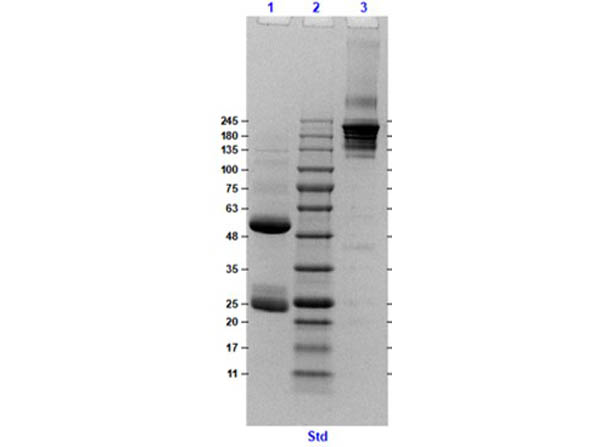
Hamster IgG whole molecule has been tested by SDS-Page and can be utilized as a control or standard reagent in Western Blotting and ELISA experiments.
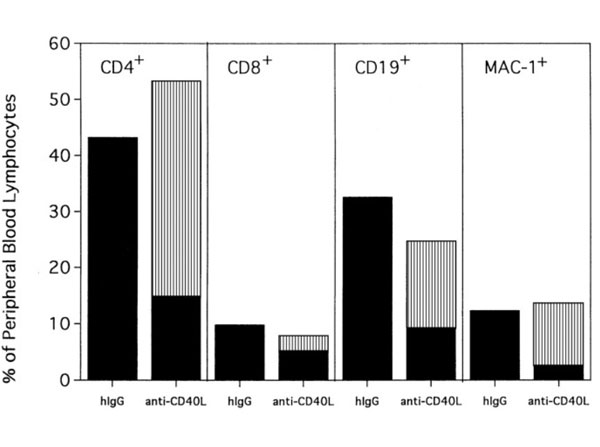
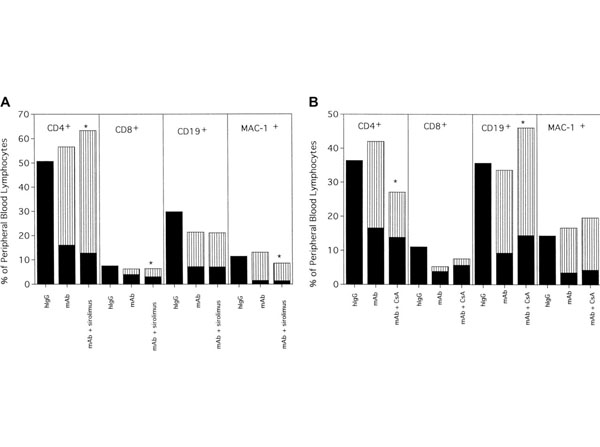
Anti-CD154-facilitated alloengraftment is multilineage.Twenty mice from 2 representative experiments shown in Figure1were phenotyped at 120 days after BMT for donor-host origin of CD4+and CD8+T cells, CD19+B cells, and MAC-1+myeloid cells. On the x-axis are shown the host and donor proportions of each of the lineages. ▪ indicates the proportion of each lineage of host origin, ▥, the proportion of each lineage that is of donor origin. On the y-axis is shown the percentage of PBLs of each lineage. Irrelevant hIgG-treated mice had no detectable donor chimerism and thus are composed entirely of host-type cells. Note that most CD4+T cells, CD19+B cells, and MAC-1+myeloid cells in anti-CD154-treated mice are of donor origin. In contrast, most of the CD8+T cells are of host origin. Fig. 3.PMID: 11435318.
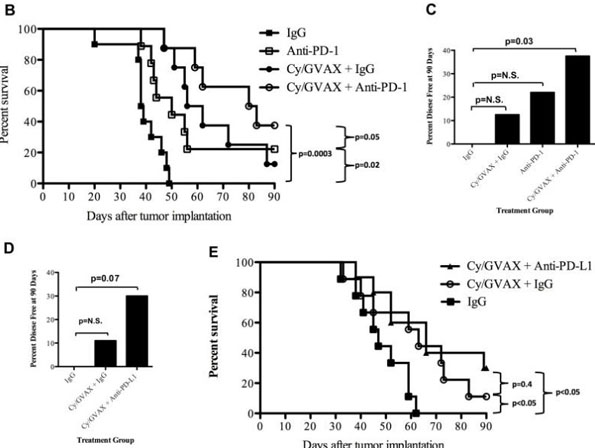
Combination therapy with Cy/GVAX and PD-1 or PD-L1 blockade improves clinical outcomes in a PDA mouse model.Anti-PD-1, anti-PD-L1 or IgG (5 mg/kg IP) were administered IP twice weekly until death starting on day 3. (B) Kaplan-Meier survival curves of mice that were implanted with PDA cells and were treated with different combinations of Cy, GVAX and the alphaPD-1 antibody. The percentages of mice that remained disease free at day 90 following tumor implantation and therapy with (C) Cy, GVAX and/or alphaPD-1 or (D) Cy, GVAX and alphaPD-L1 are shown. All the p values were yielded by comparing GVAX and/or alphaPD-1/alphaPD-L1 treatment groups with IgG treated group. (E) Kaplan-Meier survival curves of mice that were implanted with Panc02 cells via hemispleen technique and treated with different combinations of Cy, GVAX and alphaPD-L1 antibody. Data are represented as results obtained from experiments with 8-10 mice per group that were repeated at least twice.Fig 2. PMID: 25415283.
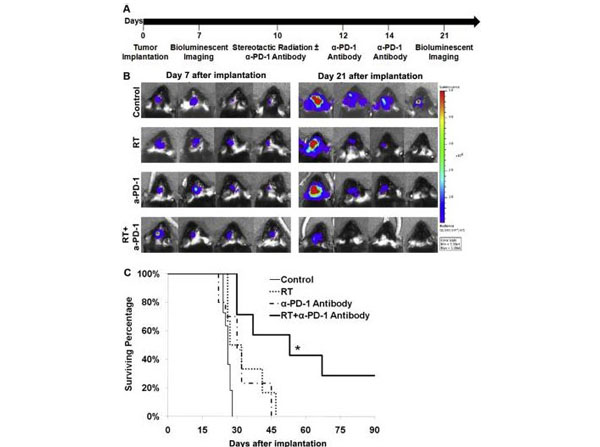
Anti-PD-1 antibody plus radiation therapy (RT) cures mice with intracranial GL261-luc tumors. (A) Experimental timeline. (B) Luciferase imaging of 4 distinct mice per treatment arm before treatment (day 7) and after treatment (day 21), divided by treatment group. All images at same scale. All mice individually matched on days 7 and 21. (C) Kaplan-Meier survival curve.P<.05 between RT+anti-PD-1 antibody arm and all other arms. All experiments repeated in triplicate with >6 mice per arm. Fig. 2. PMID: 23462419.
SDS-PAGE Results of Golden Syrian Hamster IgG Whole Molecule. Lane 1: Golden Syrian Hamster IgG Whole Molecule, Reduced [5.0µg]. Lane 2: Opal Pre-Stained Molecular Weight Marker (p/n MB-210-0500). Lane 3: Golden Syrian Hamster IgG Whole Molecule, Non-Reduced [5.0µg]. 4-20% gel, Coomassie stained.
Anti-CD40LmAbalone or in combination with (A)sirolimusor (B)CsAresults in long-term multilineageengraftment. Fig. 1.PMID: 12384443.
* Mehrwertsteuer und Versandkosten nicht enthalten. Irrtümer und Preisänderungen vorbehalten