Anti-Histone H2A.Zac Antibody was produced in rabbits by repeated immunizations with a synthetic peptide from histone H2A.Z acetylated at lysines 5, 7 and 11.
0.01 M Sodium Phosphate, 0.25 M Sodium Chloride, pH 7.2
Formulierung:
Liquid (sterile filtered)
Target-Kategorie:
Human
Antibody Type:
Primary Antibody
Application Verdünnung:
ELISA: 1:5,000, ChIP: 0.5 µg/ChIP, IF Microscopy: 1:500, WB: 1:1,000
Anwendungsbeschreibung:
Anti-Histone H2A.Zac Antibody is tested for Chromatin Immunoprecipitation, western blot, Dot Blot, ELISA, and Immunofluorescence. Specific conditions for reactivity should be optimized by the end user.
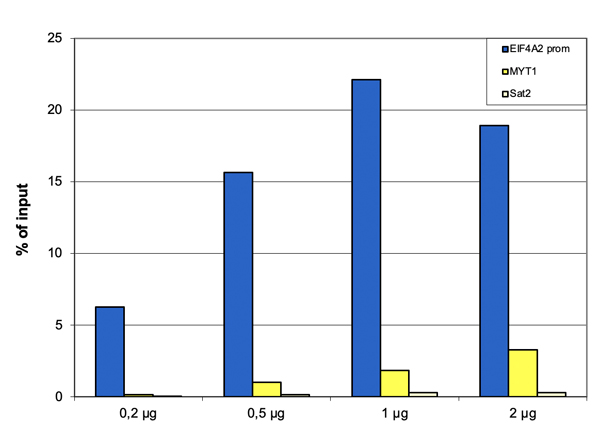
ChIP results of Anti-Histone H2A.Zac pan.ChIP assays were performed using HeLa cells, Anti-Histone H2A.Zac pan, and optimized primer pairs for qPCR. ChIP was performed on sheared chromatin from 100,000 K562 cells using the iDeal ChIP-seq kit. A titration of the antibody consisting of 0.2, 0.5, 1 and 2 µg per ChIP experiment was analysed. IgG (1 µg/IP) was used as negative IP control. QPCR was performed using primers specific for the promoter of the EIF4A2 gene, used as positive control target and for the coding region of the MYT1 gene, and the Sat2 satellite repeat, used as negative control targets. Figure shows the recovery (the relative amount of immunoprecipitated DNA compared to input DNA).
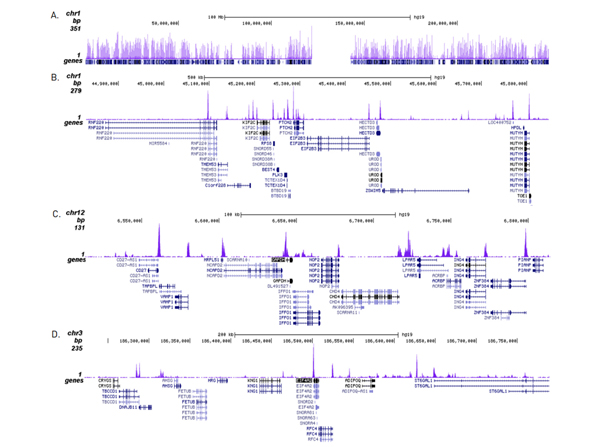
ChIP-seq results of Anti-Histone H2A.Zac pan.ChIP was performed with 0.5 µg of Anti-Histone H2A.Zac pan as described above. The IPd DNA was subsequently analysed with an Illumina Genome Analyzer. Library preparation, cluster generation and sequencing were performed according to the manufacturers instructions. The 36 bp tags were aligned to the human genome using the ELAND algorithm. Figure shows the peak distribution along the complete sequence and a 1 Mb region of human chromosome 1 (figure 2A and B) and in two regions surrounding the GAPDH and the EIF4A2 positive control gene (figure 2C and D, respectively).
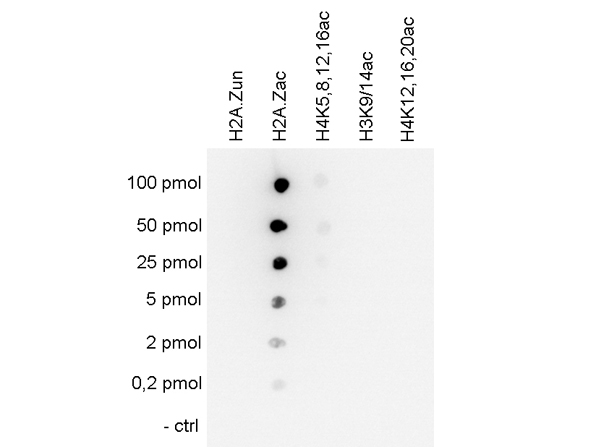
Cross reactivity test using Anti-Histone H2A.Zac pan.A Dot Blot analysis was performed to test the cross reactivity of Anti-Histone H2A.Zac pan with peptides containing other histone acetylations and the unmodified H2A.Z sequence. One hundred to 0.2 pmol of the respective peptides were spotted on a membrane. The antibody was used at a dilution of 1:20,000. Figure shows a high specificity of the antibody for the modification of interest.
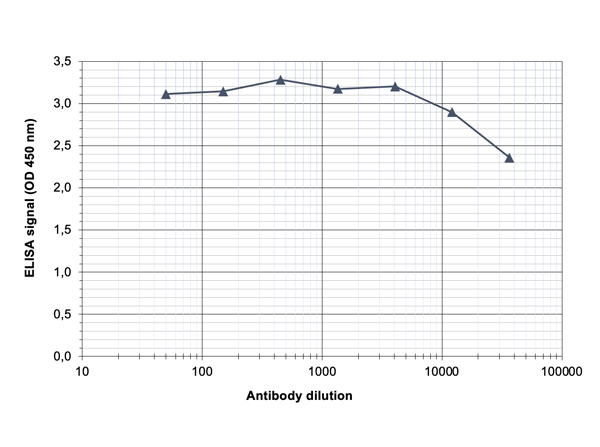
Determination of the antibody titer of Anti-Histone H2AZac pan.To determine the titer of the antibody, an ELISA was performed using a serial dilution of Anti-Histone H2AZac pan. The antigen used was a peptide containing the histone modifications of interest. By plotting the absorbance against the antibody dilution, the titer of the purified antibody was estimated to be 1:265,000.
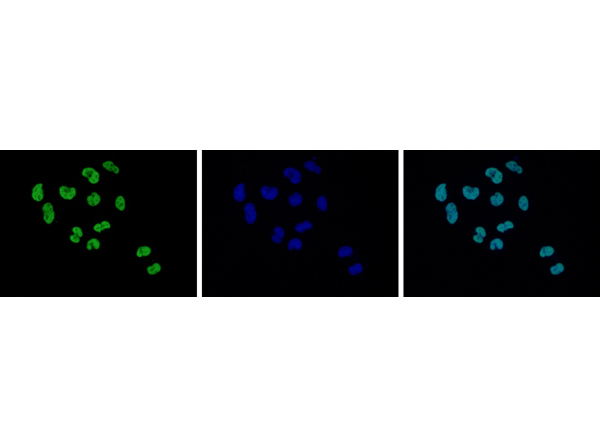
Immunofluorescence using Anti-Histone H2A.Zac pan.HeLa cells were stained with Anti-Histone H2A.Zac pan and with DAPI. Cells were fixed with 4% formaldehyde for 10 and blocked with PBS/TX-100 containing 5% normal goat serum and 1% BSA. The cells were immunofluorescently labelled with the H2A.Zac antibody (left) diluted 1:500 in blocking solution followed by an anti-rabbit antibody conjugated to Alexa488. The middle panel shows staining of the nuclei with DAPI. A merge of the two stainings is shown on the right.
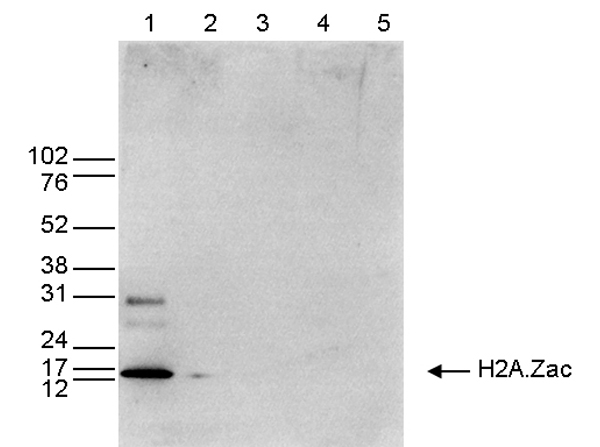
Western blot analysis using Anti-Histone H2A.Zac pan.Western blot was performed on whole cell extracts (25 µg, lane 1) from HeLa cells, and on 1 µg of recombinant histone H2A, H2B, H3 and H4 (lane 2, 3, 4 and 5, respectively) using Anti-Histone H2A.Zac pan. The antibody was diluted 1:1,000 in TBS-Tween containing 5% skimmed milk. The position of the protein of interest is indicated on the right, the marker (in kDa) is shown on the left.
* Mehrwertsteuer und Versandkosten nicht enthalten. Irrtümer und Preisänderungen vorbehalten