0.2 mg/ml in 1X PBS with 0.1 mg/ml rAlbumin, 0.05% sodium azide
Application Dilute:
Immunohistochemistry (FFPE): 1-2ug/ml
Application Notes:
Application Notes: Optimal dilution of the IGF1R antibody should be determined by the researcher
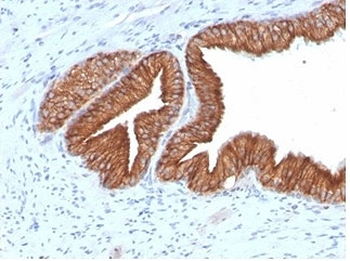
IHC staining of FFPE human prostate carcinoma tissue with IGF1R antibody (clone IGF1R/4667). HIER: boil tissue sections in pH9 10mM Tris with 1mM EDTA for 20 min and allow to cool before testing.
IHC staining of FFPE human breast carcinoma tissue with IGF1R antibody (clone IGF1R/4667). HIER: boil tissue sections in pH9 10mM Tris with 1mM EDTA for 20 min and allow to cool before testing.
IHC staining of FFPE human colon carcinoma tissue with IGF1R antibody (clone IGF1R/4667). HIER: boil tissue sections in pH9 10mM Tris with 1mM EDTA for 20 min and allow to cool before testing.
SDS-PAGE analysis of purified, BSA-free IGF1R antibody (clone IGF1R/4667) as confirmation of integrity and purity.
Analysis of HuProt (TM) microarray containing more than 19000 full-length human proteins using IGF1R antibody (clone IGF1R/4667). These results demonstrate the foremost specificity of the IGF1R/4667 mAb. Z- and S- score: The Z-score represents the strength of a signal that an antibody (in combination with a fluorescently-tagged anti-IgG secondary Ab) produces when binding to a particular protein on the HuProt (TM) array. Z-scores are described in units of standard deviations (SDs) above the mean value of all signals generated on that array. If the targets on the HuProt (TM) are arranged in descending order of the Z-score, the S-score is the difference (also in units of SDs) between the Z-scores. The S-score therefore represents the relative target specificity of an Ab to its intended target.
* VAT and and shipping costs not included. Errors and price changes excepted