E.coli-derived human Bid recombinant protein (Position: M1-D195). Human Bid shares 64% and 61% amino acid (aa) sequences identity with mouse and rat Bid, respectively.
Conjugation:
Unconjugated
Alternative Names:
Antigen KI-67, MKI67
BID Rabbit Polyclonal Antibody
Clonality:
Polyclonal
Concentration:
Adding 0.2 ml of distilled water will yield a concentration of 500 µg/ml.
Each vial contains antibody formulated with stabilizing components, 0.9 mg NaCl, 0.2 mg Na2HPO4, and 0.05 mg NaN3. *This antibody is supplied in a stabilized formulation. Compatibility with conjugation reactions depends on the chemistry of the conjugation
Form:
Lyophilized
Target:
BH3-interacting domain death agonist
Application Dilute:
Western blot, 0.1-0.5µg/ml, Human Immunohistochemistry (Paraffin-embedded Section), 0.5-1µg/ml, Human, Mouse, Rat Immunocytochemistry/Immunofluorescence, 2µg/ml, Human Flow Cytometry (Fixed), 1-3µg/1x10 6 cells, Human
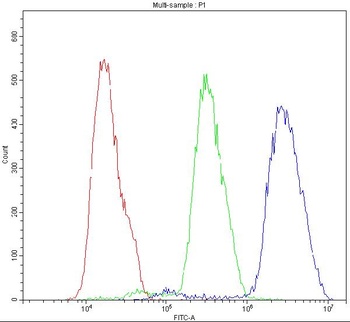
Flow Cytometry analysis of MCF-7 cells using anti-BID antibody (Blue line).Isotype control antibody (Green line) was rabbit IgG .Unlabelled sample (Red line) was also used as a control.
WB analysis of BID using anti-BID antibody.Lane 1:HELA Cell,2:COLO320 Cell,3:JURKAT Cell,4:SKOV Cell.
IF analysis of Bid using anti-Bid antibody. Bid was detected in immunocytochemical section of MCF-7 cells.
IHC analysis of BID using anti-BID antibody.BID was detected in paraffin-embedded section of human mammary cancer tissues.
IHC analysis of BID using anti-BID antibody.BID was detected in paraffin-embedded section of mouse spleen tissues.
IHC analysis of BID using anti-BID antibody.BID was detected in paraffin-embedded section of rat intestine tissues.
IHC analysis of BID using anti-BID antibody.BID was detected in immunocytochemical section of A549 cell.
* VAT and and shipping costs not included. Errors and price changes excepted