Synthesized peptide derived from CD209 antigen at AA range: 261-310
Alternative Names:
CD209, CLEC4L, CD209 antigen, C-type lectin domain family 4 member L, Dendritic cell-specific ICAM-3-grabbing non-integrin 1, DC-SIGN, DC-SIGN1, CD209
This gene encodes a transmembrane receptor and is often referred to as DC-SIGN because of its expression on the surface of dendritic cells and macrophages. The encoded protein is involved in the innate immune system and recognizes numerous evolutionarily divergent pathogens ranging from parasites to viruses with a large impact on public health. The protein is organized into three distinct domains: an N-terminal transmembrane domain, a tandem-repeat neck domain and C-type lectin carbohydrate recognition domain. The extracellular region consisting of the C-type lectin and neck domains has a dual function as a pathogen recognition receptor and a cell adhesion receptor by binding carbohydrate ligands on the surface of microbes and endogenous cells. The neck region is important for homo-oligomerization which allows the receptor to bind multivalent ligands with high avidity. Variations in the number of 23 amino a
Western Blot: 1/500 - 1/2000. ELISA: 1/10000. Not yet tested in other applications.
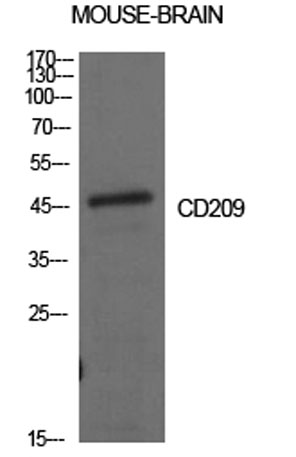
Western Blot analysis of mouse brain cells using CD209 Polyclonal Antibody. Antibody was diluted at 1:1000. Secondary antibody(catalog:RS0002) was diluted at 1:20000
* VAT and and shipping costs not included. Errors and price changes excepted