catalytic activity:ATP + a protein = ADP + a phosphoprotein.,domain:The N-terminal region (1-20) is the minimal region necessary for ubiquitination and further proteosomal degradation.,domain:The TXY motif contains the threonine and tyrosine residues whose phosphorylation activates the MAP kinases.,enzyme regulation:Activated by threonine and tyrosine phosphorylation. Inhibited by dual specificity phosphatases, such as DUSP1.,function:In vitro, phosphorylates MBP.,PTM:Dually phosphorylated on Thr-175 and Tyr-177, which activates the enzyme. Autophosphorylated on threonine and tyrosine residues in vitro.,PTM:Ubiquitinated. Ubiquitination may allow its tight kinase activity regulation and rapid turnover. May be ubiquitinated by a SCF E3 ligase.,similarity:Belongs to the protein kinase superfamily. CMGC Ser/Thr protein kinase family. MAP kinase subfamily.,similarity:Contains 1 protein kinase domain.,subunit:Interacts with CSK/c-Src, ABL1, RET and TGFB1I1.,tissue specificity:Widely expressed with a maximal expression in lung and kidney.,
Immunohistochemistry: 1/100 - 1/300. Immunofluorescence: 1/200 - 1/1000. ELISA: 1/5000. Not yet tested in other applications.
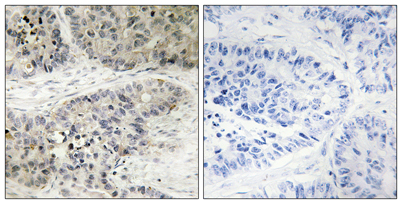
Immunohistochemistry analysis of paraffin-embedded human lung carcinoma, using MAPK15 Antibody. The picture on the right is blocked with the synthesized peptide.
* VAT and and shipping costs not included. Errors and price changes excepted