The protein encoded by this gene is a member of the fibroblast growth factor receptor (FGFR) family, where amino acid sequence is highly conserved between members and throughout evolution. FGFR family members differ from one another in their ligand affinities and tissue distribution. A full-length representative protein consists of an extracellular region, composed of three immunoglobulin-like domains, a single hydrophobic membrane-spanning segment and a cytoplasmic tyrosine kinase domain. The extracellular portion of the protein interacts with fibroblast growth factors, setting in motion a cascade of downstream signals, ultimately influencing mitogenesis and differentiation. This particular family member binds both acidic and basic fibroblast growth factors and is involved in limb induction. Mutations in this gene have been associated with Pfeiffer syndrome, Jackson-Weiss syndrome,
Western Blot: 1/500 - 1/2000. Immunofluorescence: 1/200 - 1/1000. ELISA: 1/20000. Not yet tested in other applications.
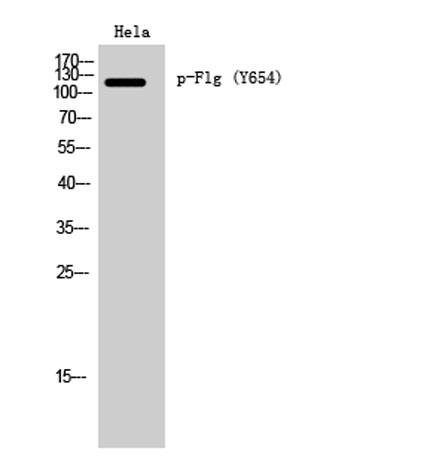
Western Blot analysis of Hela cells using Phospho-Flg (Y654) Polyclonal Antibody diluted at 1:1000
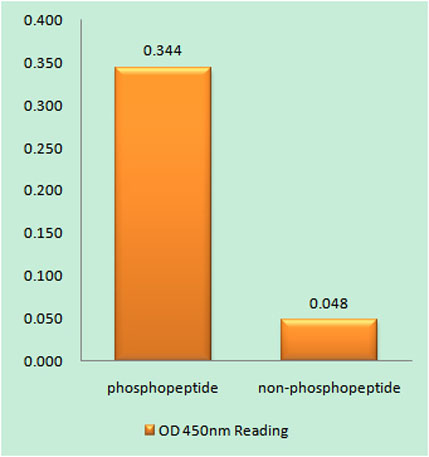
Enzyme-Linked Immunosorbent Assay (Phospho-ELISA) for Immunogen Phosphopeptide (Phospho-left) and Non-Phosphopeptide (Phospho-right), using FGFR1 (Phospho-Tyr654) Antibody
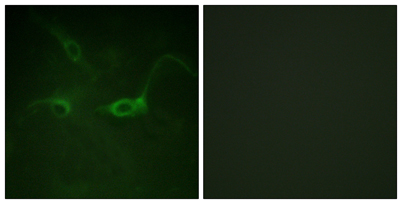
Immunofluorescence analysis of COS7 cells, using FGFR1 (Phospho-Tyr654) Antibody. The picture on the right is blocked with the phospho peptide.
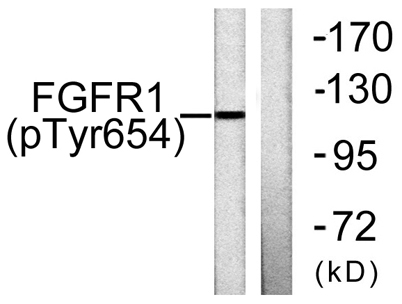
Western blot analysis of lysates from 293 cells treated with Insulin 0.01U/ml 15, using FGFR1 (Phospho-Tyr654) Antibody. The lane on the right is blocked with the phospho peptide.
* VAT and and shipping costs not included. Errors and price changes excepted