The antiserum was produced against synthesized peptide derived from human Huntingtin around the phosphorylation site of Ser421. AA range:387-436
Alternative Names:
HTT, HD, IT15, Huntingtin, Huntington disease protein, HD protein
huntingtin(HTT) Homo sapiens Huntingtin is a disease gene linked to Huntingtons disease, a neurodegenerative disorder characterized by loss of striatal neurons. This is thought to be caused by an expanded, unstable trinucleotide repeat in the huntingtin gene, which translates as a polyglutamine repeat in the protein product. A fairly broad range of trinucleotide repeats (9-35) has been identified in normal controls, and repeat numbers in excess of 40 have been described as pathological. The huntingtin locus is large, spanning 180 kb and consisting of 67 exons. The huntingtin gene is widely expressed and is required for normal development. It is expressed as 2 alternatively polyadenylated forms displaying different relative abundance in various fetal and adult tissues. The larger transcript is approximately 13.7 kb and is expressed predominantly in adult and fetal brain whereas the smaller transcript of approximately 10.3 kb is more widel
Immunohistochemistry: 1/100 - 1/300. ELISA: 1/5000. Not yet tested in other applications.
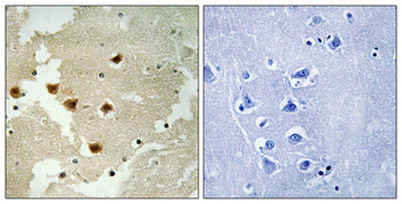
Immunohistochemical analysis of paraffin-embedded Human brain. Antibody was diluted at 1:100(4 overnight). High-pressure and temperature Tris-EDTA,pH8.0 was used for antigen retrieval. Negetive contrl (right) obtaned from antibody was pre-absorbed by immunogen peptide.
* VAT and and shipping costs not included. Errors and price changes excepted