Biotin conjugated to Keyhole Limpet Hemocyanin (KLH)
Conjugation:
Unconjugated
Alternative Names:
rabbit anti-biotin antibody, rabbit anti biotin
Clonality:
Polyclonal
Concentration:
90 mg/mL by Refractometry
Buffer:
0.01 M Sodium Phosphate, 0.15 M Sodium Chloride, pH 7.2
Form:
Lyophilized
Antibody Type:
Primary Antibody
Application Dilute:
ELISA: 1:100,000, IHC: User Optimized, WB: 1:10,000 - 1:25,000
Application Notes:
Anti-Biotin has been tested in ELISA and is suitable for immunoblotting (western or dot blot), immunoprecipitation and most immunological methods requiring high titer and specificity.
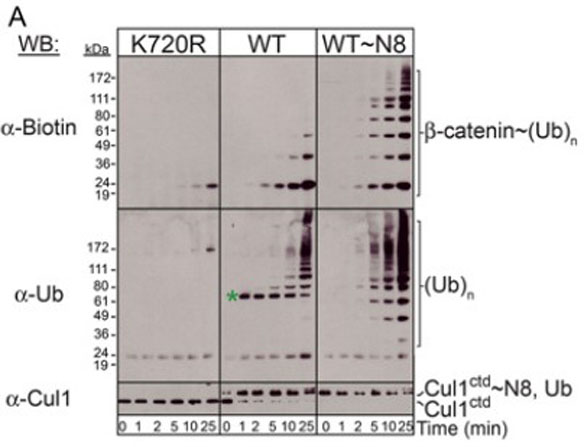
Western Blot of Anti-Biotin antibody.Conformational control of CRL activities.(A)Polyubiquitination reactions with SCFbetaTRCP/beta-catenin phosphopeptide (left), and SCFSkp2/CksHs1/ phospho-p27 (right) reconstituted with non-NEDD8ylatable (K720R), un-NEDD8ylated wild-type (WT), and fully NEDD8ylated Cul1-Rbx1 (WT~N8). Reaction products were detected by immunoblotting, top panels with anti-biotin (left) or anti-p27 (right), middle with anti-His (Ubiquitin, green * - Cul1~Ubiquitin), and lower with anti-Cul1 C-terminus antisera. Figure 7. PMID: 18805092.
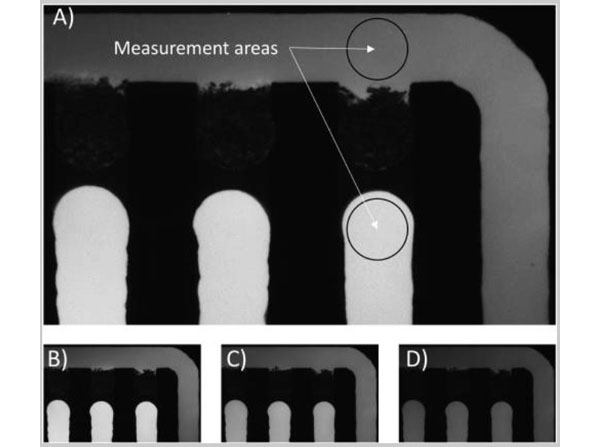
Typical experiment image where the complexes Ag-AbI-AbII are attached to the nanoparticles trapped in the magnetic traps and the fluorogenic substrate is flowed at different rates, where the measurement areas selected for the fluorescence analysis are shown. Measurement with a flow rate of (a) 1µl/h, (b) 2µl/h, (c) 5µl/h, and (d) 10µl/h. Experiment with anti-rabbit IgG labeled alkaline phosphatase was used (p/n 611-1502) and an anti-biotin rabbit IgG (p/n 100-4198) [AbI] concentration of 100pg/ml. FIG. 6. PMID: 32038740.
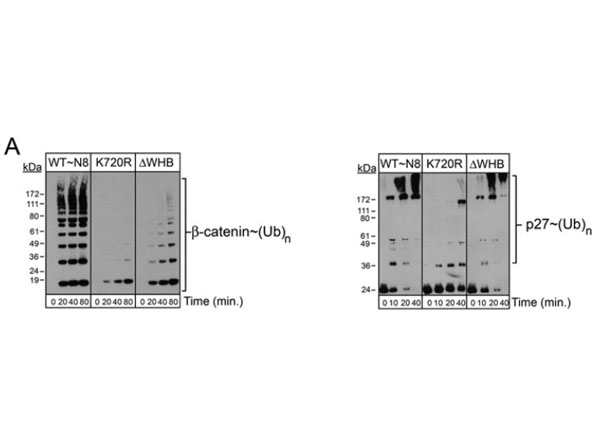
Western Blot of Anti-Biotin Antibody.Functional analysis of mutations influencing RING conformational flexibility. (A)Time-courses of polyubiquitination by SCFs reconstituted with fully-NEDD8ylated wild-type Cul1-Rbx1 (WT~N8), the non-NEDD8ylatable control (K720R), and the Cul1-Rbx1 WHB deletion mutant (deltaWHB). Left - SCFbetaTRCP-mediated polyubiquitination of a biotin-labeled beta-catenin phosphopeptide, detected by western blotting with anti-biotin antisera. Right - SCFSkp2/CksHs1-mediated polyubiquitination of phospho-p27, detected by western blotting with anti-p27 antisera. Figure 5. PMID: 18805092.
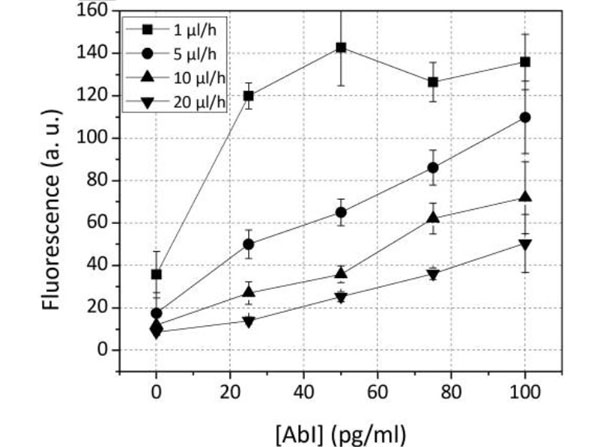
Shows the fluorescence difference from immunoassays at various concentrations of the primary antibody.Calibration curve: fluorescence difference from immunoassays with varying concentrations of anti-biotin rabbit IgG (p/n 100-4198) [AbI] at different flow rates of the fluorogenic enzyme substrate anti-rabbit IgG labeled alkaline phosphatase was used (p/n 611-1502). Each experiment was repeated on three different devices. FIG. 7. PMID: 32038740.
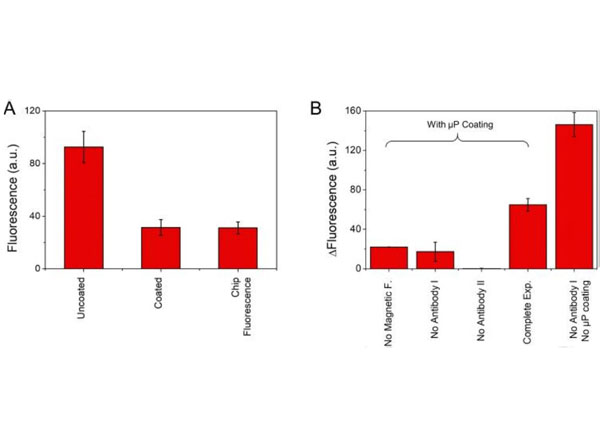
(a) Channels coating: remnant fluorescence due to nonspecific binding of anti-rabbit IgG labeled with B-rhodamine (p/n 611-1003) [AbII] at a concentration of 100µg/ml in uncoated and coated microchannels with silane-PEG. (b) Fluorescence obtained from the complete immunoassay at a flow rate of 5µl/h and at a anti-biotin rabbit IgG (p/n 100-4198) [AbI] concentration of 50pg/ml is compared to the fluorescence obtained from the immunoassay performed without applying the magnetic field (column 1), without adding anti-biotin rabbit IgG (p/n 100-4198) [AbI] (column 2), without adding ), anti-rabbit IgG labeled with B-rhodamine (p/n 611-1003) [AbII] (column 3), and, finally, the efficacy of the microparticles coating was tested by performing the immunoassay without anti-biotin rabbit IgG (p/n 100-4198) [AbI] and with noncoated microparticles (column 5). The level of fluorescence of the two first columns in b results from nonspecific interactions of anti-rabbit IgG labeled with B-rhodamine (p/n 611-1003) [AbII] with the microparticles. Error bars are standard deviation. FIG. 5. PMID: 32038740.
* VAT and and shipping costs not included. Errors and price changes excepted