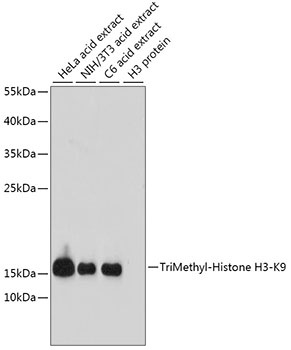
Western blot analysis of extracts of various cell lines, using TriMethyl-Histone H3-K9 antibody (orb1258188) at 1:1000 dilution. Secondary antibody: HRP Goat Anti-Rabbit IgG (H+L) at 1:10000 dilution. Lysates/proteins: 25 ug per lane. Blocking buffer: 3% nonfat dry milk in TBST. Detection: ECL Basic Kit. Exposure time: 5s.
Dot-blot analysis of all sorts of methylation peptides using TriMethyl-Histone H3-K9 antibody (orb1258188).
Immunohistochemistry of paraffin-embedded rat testis using TriMethyl-Histone H3-K9 antibody (orb1258188) at dilution of 1:200 (40x lens).
Immunohistochemistry of paraffin-embedded mouse testis using TriMethyl-Histone H3-K9 antibody (orb1258188) at dilution of 1:200 (40x lens).
Immunofluorescence analysis of 293T cells using TriMethyl-Histone H3-K9 antibody (orb1258188). Blue: DAPI for nuclear staining.
Chromatin immunoprecipitation analysis of extracts of 293T cells, using TriMethyl-Histone H3-K9 antibody (orb1258188) and rabbit IgG. P1 and P2 were located on EBAG9 gene. The amount of immunoprecipitated DNA was checked by quantitative PCR. Histogram was constructed by the ratios of the immunoprecipitated DNA to the input.
* Mehrwertsteuer und Versandkosten nicht enthalten. Irrtümer und Preisänderungen vorbehalten